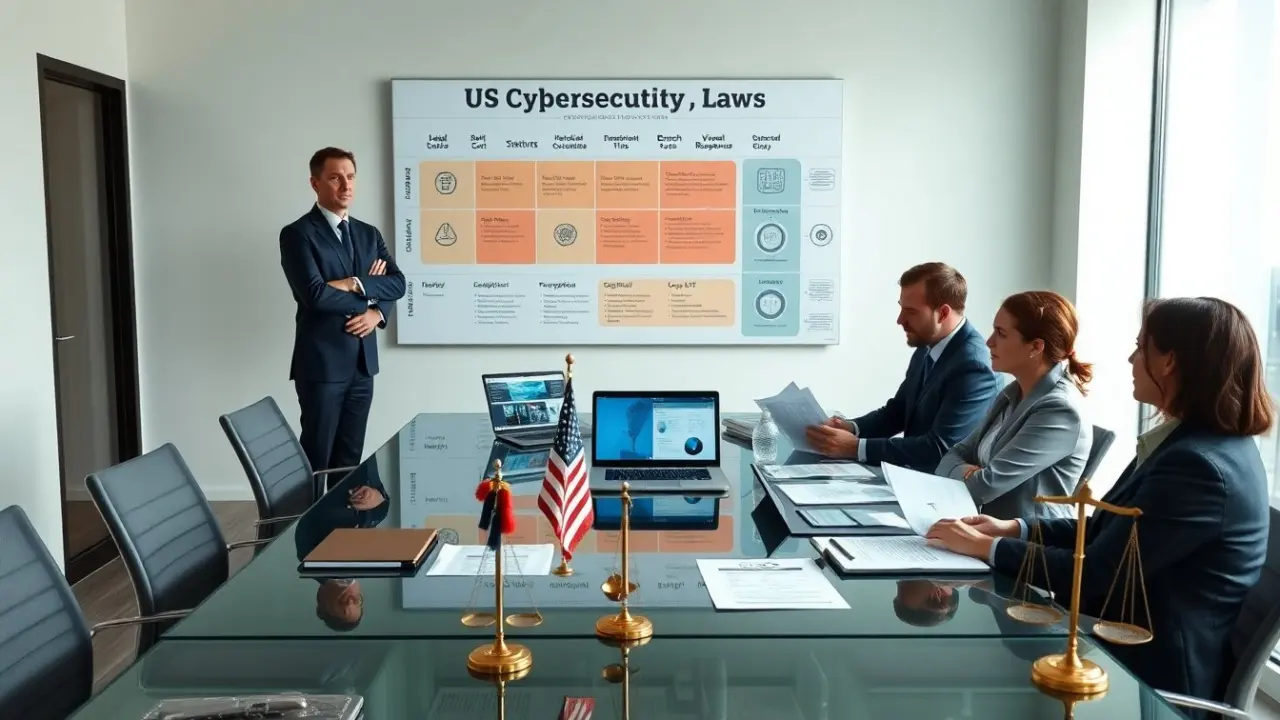
US cybersecurity laws set rules for data protection and incident reporting. This guide explains US cybersecurity laws for businesses and individuals. It lists key federal statutes, agency roles, and state differences. It shows practical steps for risk assessment, breach response, and penalties. It aims to help readers meet legal obligations and reduce legal risk under US cybersecurity laws.
Key Takeaways
- US cybersecurity laws include key federal statutes like the Computer Fraud and Abuse Act and the Federal Information Security Modernization Act that set the legal framework for data protection and cybercrime enforcement.
- State laws vary significantly, with states like California and New York enacting strong privacy and breach notification requirements that businesses must track carefully.
- Federal agencies such as the Department of Justice and the Federal Trade Commission play critical roles in enforcing cybersecurity laws and penalizing violations.
- Organizations should conduct thorough risk assessments and develop detailed incident response plans to comply with US cybersecurity laws and limit legal exposure.
- Implementing strong security controls like multi-factor authentication, encryption, and regular staff training helps meet legal obligations and reduce breach risk.
- Documenting compliance efforts and following NIST guidelines can reduce penalties, insurance denials, and civil liabilities under US cybersecurity laws.
How Federal Cybersecurity Law Works: Key Statutes And Agencies
The federal government enacts laws and assigns agencies to enforce them. The main federal statutes include the Computer Fraud and Abuse Act, the Electronic Communications Privacy Act, and the Federal Information Security Modernization Act. The Computer Fraud and Abuse Act criminalizes unauthorized access to computers. The Electronic Communications Privacy Act protects electronic communications. The Federal Information Security Modernization Act requires agencies to secure federal systems.
Several agencies enforce federal law. The Department of Justice prosecutes cybercrimes. The Federal Trade Commission enforces consumer data protection and can penalize unfair data practices. The Cybersecurity and Infrastructure Security Agency sets guidance and coordinates incident response for critical infrastructure. The Securities and Exchange Commission enforces disclosure rules for public companies. The National Institute of Standards and Technology issues security standards that agencies and businesses often follow.
Federal law operates through a combination of statutes, agency regulations, guidance documents, rulemaking, and litigation. For example, when agencies identify systemic problems they may issue enforcement actions, guidance on best practices, or consent decrees that impose specific requirements on organizations. These enforcement outcomes help shape industry expectations of “reasonable” security under US cybersecurity laws.
Federal obligations are often triggered by the nature of data, the sector of operation, or federal contracts. Healthcare entities that work with federal health programs must also follow HIPAA security rules, while financial institutions face regulations from banking regulators and the SEC. Organizations that handle critical infrastructure may be subject to mandatory reporting or sector-specific cybersecurity standards issued or coordinated by federal agencies.
Understanding how agencies coordinate is important: the Department of Justice prosecutes criminal conduct, the FTC and state attorneys general pursue consumer protection claims, and sectoral regulators (for example, the SEC or banking regulators) pursue compliance and disclosure matters. Coordination across federal and state authorities means organizations can face multiple parallel investigations under US cybersecurity laws after a breach.
State-Level Rules And Notable Laws: What Varies By State
States set their own rules for data protection and breach handling. Many states require companies to notify residents after a data breach. States differ in definitions, covered data types, and enforcement powers. Businesses must track state laws where they operate and where their customers live.
California, New York, and several other states lead with strong rules. California passed the California Consumer Privacy Act and the California Privacy Rights Act. These laws give consumers rights to access and delete personal data. New York passed the Stop Hacks and Improve Electronic Data Security Act and set cybersecurity requirements for financial services. Other states, like Virginia and Colorado, passed comprehensive privacy laws that mirror parts of California’s law. States add rules for sector-specific data, such as health or student records.
Notification timelines, thresholds for reporting, and the definition of “personal information” differ across states. Some states require notice to a state regulator as well as affected individuals; others impose specific content requirements for breach notices. Businesses should maintain a central registry of state notification deadlines and sample notices that comply with the strictest applicable rules to avoid missed requirements under US cybersecurity laws.
State enforcement varies too: state attorneys general typically have authority to investigate and bring civil enforcement actions, and some statutes create private rights of action for consumers or provide statutory damages. This means a single breach can trigger state-level investigations, civil litigation, and class actions in multiple jurisdictions. Businesses should anticipate this multi-front exposure when planning incident response and remediation.
Practical differences also appear in vendor and contract law. States may interpret contractual indemnities, data processing obligations, and consumer rights differently, so organizations should tailor vendor agreements, data processing addenda, and insurance provisions to reflect where their customers and data subjects reside. Regularly reviewing state law developments is essential for maintaining compliance across jurisdictions under US cybersecurity laws.
Practical Compliance Steps: Risk Assessment, Incident Response, And Penalties
Organizations should start with a risk assessment. A team should identify assets, threats, and vulnerabilities. The team should document findings and assign risk owners. The assessment helps set priorities and budget.
A well-documented risk assessment includes an inventory of systems and data, classification of data sensitivity, threat scenarios, likelihood and impact ratings, and an actionable remediation plan. Regular reassessment—quarterly or after significant changes—helps demonstrate ongoing compliance diligence under US cybersecurity laws and creates a factual record that can be useful in regulatory or litigation contexts.
Next, organizations should build an incident response plan. The plan should name roles, list communication steps, and define legal notification triggers. The plan should include data backups, containment steps, and forensic procedures. Organizations should test the plan with exercises and update it after tests or real incidents.
Incident response plans should also specify criteria for notifying regulators, customers, and third-party partners, and include templates for different notification scenarios. The plan should assign an internal legal point person and identify outside counsel and forensic vendors in advance. Maintaining an evidence-preservation protocol helps protect privilege and supports regulatory and insurance processes after an incident under US cybersecurity laws.
Security controls reduce risk. Controls include strong access controls, encryption for sensitive data, multi-factor authentication, and logging. The organization should patch systems promptly and train staff on phishing and safe data handling. The organization should follow NIST guidance and map controls to legal requirements.
Vendor management is a key compliance area: require written security obligations in contracts, perform due diligence before onboarding, and conduct ongoing monitoring. For cloud and managed service providers, ensure contractual rights to audit, data handling descriptions, and incident notification timelines are clear. Robust vendor governance reduces third-party risk and helps satisfy regulatory expectations under US cybersecurity laws.
Penalties vary by law. Violations can lead to fines, statutory damages, and injunctive relief. Regulators may require remediation and monitoring. Courts may award consumer damages when negligence or misrepresentation exists. Insurance can help cover costs, but insurers may deny coverage for poor security practices. Firms that document risk assessments and follow reasonable practices often reduce regulatory penalties and civil exposure under US cybersecurity laws.
To limit penalties and legal exposure, maintain comprehensive documentation: risk assessments, policy versions, training attendance records, patching logs, and incident timelines. Regular internal audits and third-party assessments provide independent validation of controls. Prompt, transparent engagement with regulators after an incident, combined with documented remediation steps, often mitigates enforcement outcomes.
Common pitfalls to avoid include failing to map data flows, relying on default vendor security settings without verification, neglecting employee training, and missing state-specific notification deadlines. Small and medium-sized businesses should prioritize basic, high-impact controls—inventory, MFA, patch management, backups, and phishing training—because regulators evaluate the reasonableness of security measures in context.
Finally, integrate compliance into business processes: include cybersecurity clauses in procurement, require privacy and security input in product development, and coordinate legal, IT, and business leaders. Treating US cybersecurity laws as a cross-functional obligation helps turn compliance from a checkbox into a risk-reducing business capability.