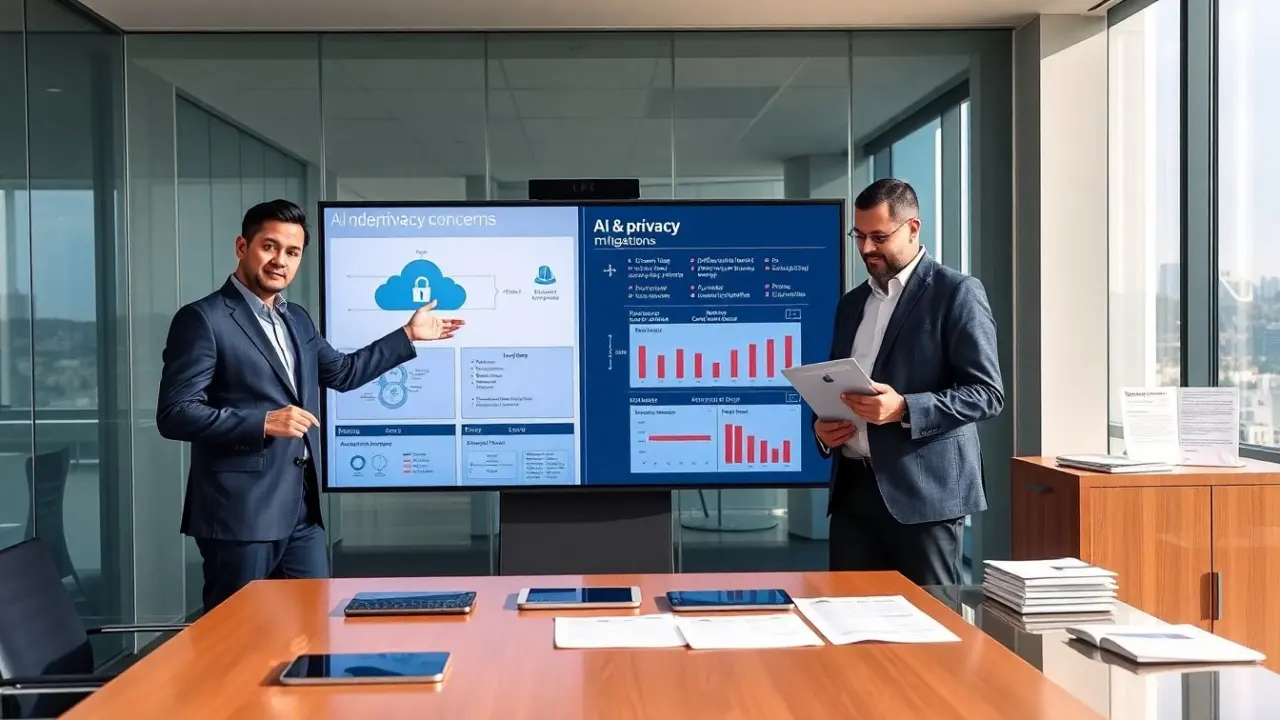
AI and privacy concerns appear in many news reports and policy briefings. The topic affects consumers, businesses, and regulators. The article explains how AI creates new privacy risks and what people and organizations can do. It lists legal, technical, and organizational mitigations. It aims to give clear, actionable points for readers who want to reduce exposure and protect personal data in 2026.
Key Takeaways
- AI and privacy concerns arise as AI systems collect and infer sensitive personal data from diverse sources, increasing risks of data leaks and misuse.
- To address AI and privacy concerns, organizations should implement legal compliance, technical safeguards like encryption and differential privacy, and strong governance practices including regular audits and staff training.
- Practical actions for organizations include mapping data flows, limiting data retention, running bias checks, and establishing clear user privacy notices with opt-out options.
- Individuals can protect their privacy by limiting app permissions, using privacy settings, avoiding sharing sensitive text in public AI tools, and promptly updating software for security patches.
- Support for stronger AI and privacy regulations can encourage companies to adopt safer defaults and transparent data use disclosures, reducing overall privacy risks.
How AI Creates New And Unique Privacy Risks
AI and privacy concerns increase as models use more data and more personal signals. Companies collect behavior data, location data, and device data. Algorithms combine these inputs and infer sensitive traits. An app can predict health status, political views, or relationships from small data points. Attackers can reidentify individuals from aggregated datasets. Data brokers can merge profiles and sell them. Models can leak training data through outputs or prompts. A user can share a fragment and receive a response that contains private text from the training set. Surveillance systems can link faces across cameras and build movement histories. Voice assistants can record unintentionally and store audio in the cloud. Edge devices can expose raw sensor streams when manufacturers skip encryption. AI systems can expand the scope of data collection by deriving new attributes. Derived attributes can be more sensitive than the original inputs. Organizations can misuse inferred data for targeting or denial of service. Bias in training data can produce differential privacy harms. A marginalized group can face higher risks because models treat their data differently. Automated decision tools can act without human review and deny services. The lack of transparency makes it hard for people to contest decisions. Regulators can lag behind technology changes. The gap creates legal uncertainty and uneven protections across jurisdictions. Public-facing APIs and model marketplaces can increase exposure. A single misconfigured endpoint can leak batches of user content. In practice, the mix of scale, inference, and integration makes AI and privacy concerns both broader and harder to manage than classic data issues.
Mitigations: Legal, Technical, And Organizational Approaches
Lawmakers and regulators can set rules that limit unnecessary collection and require clear consent. Data protection laws can mandate purpose limits and data minimization. Regulators can require impact assessments for high-risk AI systems. These assessments can focus on privacy, fairness, and security. Companies can document training data sources and update privacy notices. Contracts with vendors can include audit rights and data use limits. Technically, teams can apply encryption at rest and in transit. They can use tokenization to hide identifiers. Differential privacy can reduce reidentification risk when models train on personal data. Teams can apply access controls and logging to APIs that return model outputs. They can add rate limits and anomaly detection to detect mass extraction attempts. Model providers can carry out output filters to prevent verbatim reproduction of training examples. They can apply watermarking and provenance tags to trace model outputs. Organizations can adopt secure development practices and threat modeling that include privacy tests. They can run red-team exercises to find leaks. They can use synthetic data when possible to reduce use of real personal records. They can keep human reviewers to monitor sensitive outputs. Audits by third parties can validate privacy claims. Insurance products can cover residual harms and encourage better governance. Governance measures can include clear ownership of privacy risk, regular training for staff, and incident playbooks. Boards can require quarterly reviews of AI and privacy concerns and request metrics. These steps reduce risk but do not eliminate it. Stakeholders should plan for detection, response, and remediation when breaches occur.
Practical Actions For Organizations And Individuals
Organizations should map data flows and label personal data. They should delete data that no longer serves a documented purpose. Teams should log model queries and set retention windows. They should require multi-factor authentication for admin access. Security teams should run extraction tests that simulate attackers working to expose the training set. They should run bias checks on outputs and measure error rates across groups. Legal teams should draft clear user notices that explain how models use data. They should add opt-out mechanisms for profiling and automated decisions. Organizations should provide simple pathways for individuals to request deletion or correction. They should keep incident response plans that include notification timelines and communication templates. Individuals should limit app permissions and audit connected devices. They should use privacy settings on accounts and turn off unnecessary sensors. They should avoid pasting sensitive text into public AI tools and prefer services that publish data-use policies. They should use alias emails and payment methods when they want to reduce linkability. Individuals should review privacy reports from major providers and revoke stale app access. They should enable encrypted backups where available. Both organizations and individuals should update software promptly to receive security patches. Both should support policies that require higher standards for AI and privacy concerns. Public pressure can move companies to adopt safer defaults and clearer disclosures.